

Are Tier 1 solar panels actually better?Copy section link
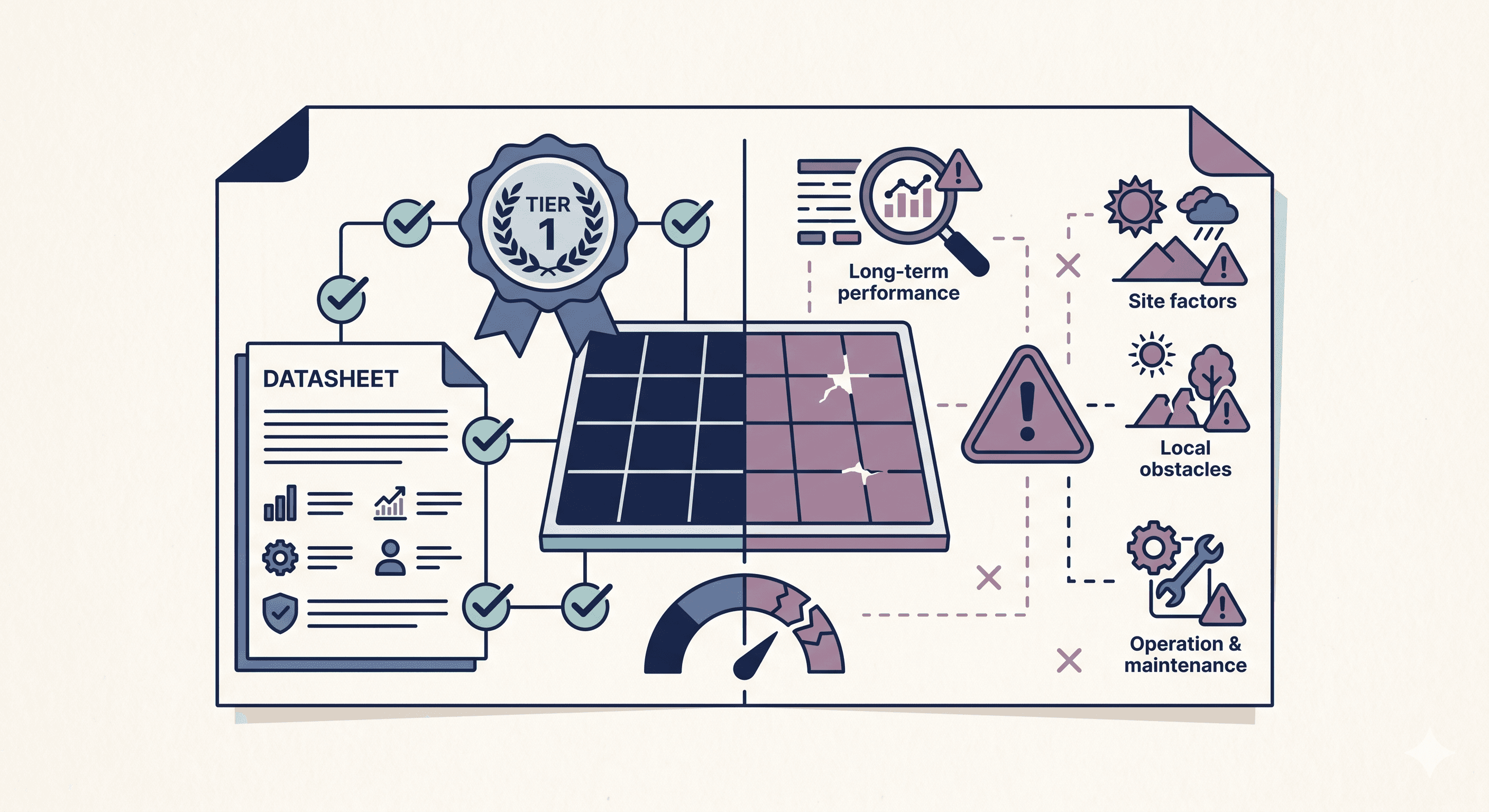
Tier 1 is often used in sales conversations as if it means best quality. That is not precise enough. The label is usually connected to manufacturer bankability and track record in financed projects. It can be useful, but it does not tell you the exact module model, temperature behavior, warranty path, degradation rate, or whether the supplier will actually deliver the same module named in the quotation. A buyer still needs the datasheet.
Tier 1 is not a complete equipment specificationCopy section link
The proposal reading guide warns against generic equipment labels for this reason. If a proposal says only Tier 1 panels, you cannot verify cell technology, module dimensions, output tolerance, temperature coefficient, glass type, frame detail, warranty document, or degradation curve. You also cannot easily confirm whether a later substitution is equal.
The same brand can sell different module linesCopy section link
Even strong manufacturers sell multiple product families. One may be optimized for higher wattage, another for better temperature performance, another for a particular cell technology or form factor. If two suppliers both quote a familiar brand but different models, the proposals are not technically identical. Comparing them as equal because the brand label matches can hide meaningful differences.
Temperature coefficient matters in PakistanCopy section link
Pakistan's operating conditions make temperature behavior worth checking. Panels are rated under standard test conditions, but real roofs get hot. A module with a weaker temperature coefficient can lose more output as cell temperature rises. Buyers do not need to become engineers, but they should make sure the supplier can explain why the proposed module fits local operating conditions and expected generation.
Warranty years are weaker than warranty processCopy section link
Solar panel warranties often show long headline terms, but the useful question is how a claim works. Who diagnoses the issue, what evidence is required, who contacts the distributor or manufacturer, who pays for removal and replacement labor, and what happens if the exact model is no longer available? A warranty with no local claim path is weaker than it looks.
Tier 1 language is a common proposal red flag when it replaces detailCopy section link
The label becomes dangerous when it is used to avoid specificity. In the misleading assumptions guide, generic premium or Tier 1 wording is treated as a red flag because it can hide substitutions, weaker warranty terms, or an inability to compare suppliers fairly.
A strong panel answer is specific and boringCopy section link
Good panel documentation is not theatrical. It simply names the equipment, attaches the datasheet, explains why the model fits the site, and states how warranty support works. Use the equipment question in the 12 supplier questions to force every bidder onto the same level of detail.
Panel verification checklist
- ✓Ask for exact module brand, model, wattage, datasheet, and warranty document.
- ✓Check temperature coefficient, product warranty, performance warranty, and degradation terms.
- ✓Confirm who handles local warranty claims and replacement logistics.
- ✓Do not accept Tier 1 as a substitute for a named module in the quotation.
Frequently asked questions
Not automatically. Tier 1 is generally a bankability classification connected to manufacturer financing and market track record. It is not a complete quality grade for a specific module model.
Not purely because of the label. Some non-Tier 1 products may still be acceptable if datasheets, certifications, warranty terms, supplier track record, and local support are strong. The buyer should verify the model, not only the category.
It should name brand, model, wattage, cell technology, warranty term, degradation rate, certifications, and whether the quoted module is the exact module to be delivered.
They should not do so without written approval. Put an equivalence rule in the contract: any substitution must be equal or better on specified datasheet and warranty criteria.
Look at exact model, module efficiency, temperature coefficient, product warranty, performance warranty, first-year degradation, annual degradation, certifications, and local warranty process.
Sources and notes
Continue with adjacent guides
Buyer action
Want to verify the panel model behind a Tier 1 claim?
Send the quoted equipment list and we'll help you check model specificity, datasheets, warranty terms, and substitution risk.