

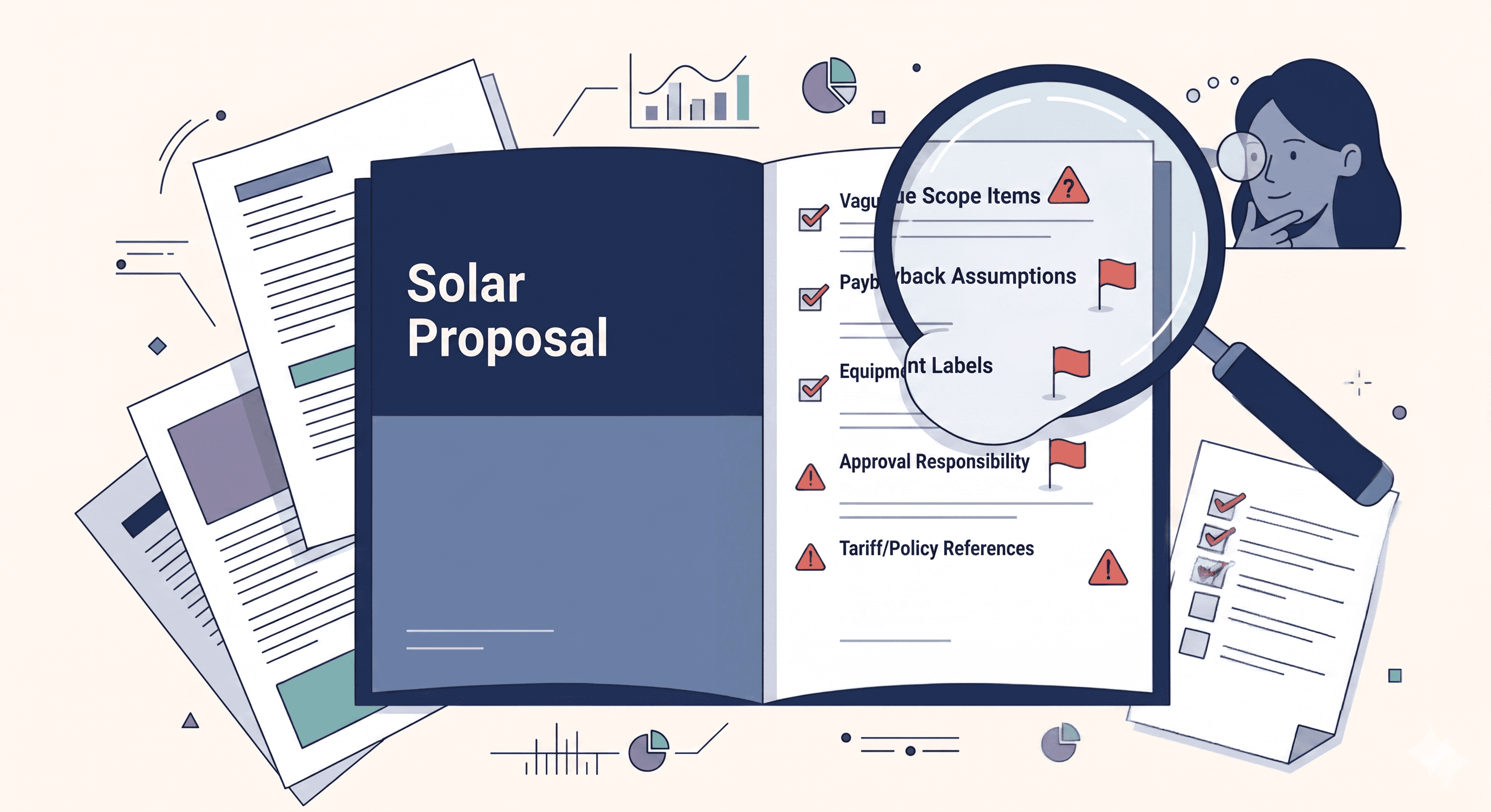
This guide is about assumptions, not basic quote decodingCopy section link
Some proposal problems are visible on the first read. Others hide inside the model itself. This page focuses on the second type: the assumptions that quietly change output, payback, approvals risk, or comparability even when the quotation looks professionally prepared.
Red flag: "Standard scope" or "as required" line itemsCopy section link
Tidy formatting is not the same as complete scope. Line items like "as required," "standard protections," or "support if needed" usually mean the work has not been priced. The decoding mechanics live in How to Read a Solar Proposal in Pakistan; the red flag here is the pattern itself: when a polished-looking quote uses placeholder language, treat it as incomplete pricing, not a documentation quirk.
Red flag: Export-heavy savings models without a downside caseCopy section link
Buyers often see annual unit generation or payback calculations without being shown the export and self-consumption assumptions behind them. If savings depend heavily on exported electricity, the proposal should be pressure-tested under current net-billing economics and a conservative usage case. For the full method, use How to Compare Solar Payback Claims in Pakistan.
Red flag: DISCO ownership left as "we will assist"Copy section link
Some proposals quietly assume that approvals, documentation, and DISCO-related steps will proceed without friction. But for the buyer, responsibility gaps matter. If nobody is clearly accountable for paperwork, submissions, revisions, or handoff, use the DISCO approval and documentation guide to pin down ownership before award.
Red flag: Site-condition assumptions that are not tied to a real site reviewCopy section link
Another hidden assumption sits in the production model itself. A proposal may look rigorous while quietly assuming a cleaner roof, less shading, fewer losses, or a better consumption pattern than your site really has. Those assumptions then flow straight into the payback claim. If you do not ask where the numbers came from, you can approve a proposal that is internally consistent but externally unrealistic.
Red flag: "Tier 1" or "premium" labels without exact model numbersCopy section link
Terms such as premium, Tier 1, high efficiency, or complete solution can hide meaningful differences. If exact models, support terms, or balance-of-system details are unclear, buyers can assume they are comparing equivalent offers when they are not. That is why structured proposal review matters.
Red flag: No SRO reference or tariff date in the financial modelCopy section link
In 2026 this matters more than ever because NEPRA refreshed the prosumer framework and then amended it again within weeks. A proposal can be professionally formatted and still be outdated if the savings case is running on an older export-value assumption or undocumented legacy logic. Cross-check the policy basis against the net billing guide before trusting the model.
A simple way to pressure-test a polished proposalCopy section link
- Check what is actually included. Make sure the quotation names the real scope, not just the attractive headline items.
- Check which assumptions drive the savings case. Ask about exports, site conditions, approvals, and exclusions in plain language.
- Check what changes if those assumptions weaken. If the proposal falls apart quickly, the polish is doing more work than the underlying logic.
Quick checklist
- ✓Look for assumptions about export value, tariff conditions, or future savings that are not clearly explained.
- ✓Check whether the quotation assumes approvals, paperwork, or documentation support without naming responsibility.
- ✓Watch for generic hardware descriptions that make weaker equipment look equivalent to stronger options.
- ✓Ask what would change in price, timeline, or output if the proposal's assumptions prove wrong.
Frequently asked questions
Look at the assumptions, not the headline number. If a fast payback depends on generous export value, an exclusion-heavy scope, or a usage profile that doesn't match your site, the proposal is more persuasive than it is dependable.
The combination is more dangerous than any single claim: a tidy-looking quote with generic equipment labels, an export-heavy savings model, and approval responsibility left vague. Each of those is testable individually, but together they often hide the same gap: a thinner scope than the headline suggests.
"Tier 1" is a financial bankability classification, not a performance or quality grade. Ask for exact module brand and model, then verify the datasheet, certifications, and warranty terms.
Treat that as a buying risk. Without exact models you cannot verify specifications, certifications, or warranty support. A supplier confident in their equipment will not hesitate to share datasheets and model numbers.
Ask which exact NEPRA regulation version, SRO date, and tariff date the financial model uses. If the answer is verbal only, ask for it in writing in the commercial summary. Stale policy assumptions inside a polished proposal is one of the most common 2026 buyer traps.
Sources and notes
Continue with adjacent guides
Buyer action
Need a second look before you sign?
Share your proposal details and we'll help you pressure-test the assumptions before you commit.