

Is net metering ending in Pakistan?Copy section link
For new solar applications, the practical answer is yes: the current NEPRA Prosumer Regulations 2026 use a net billing arrangement. Existing agreements signed under earlier distributed-generation rules retain their original terms for the period stated in the agreement, but new proposals should not be modelled as if export units still carry old net-metering-style value. Buyers should ask suppliers to name the exact regulation, SRO date, and export-value basis used in the financial model.
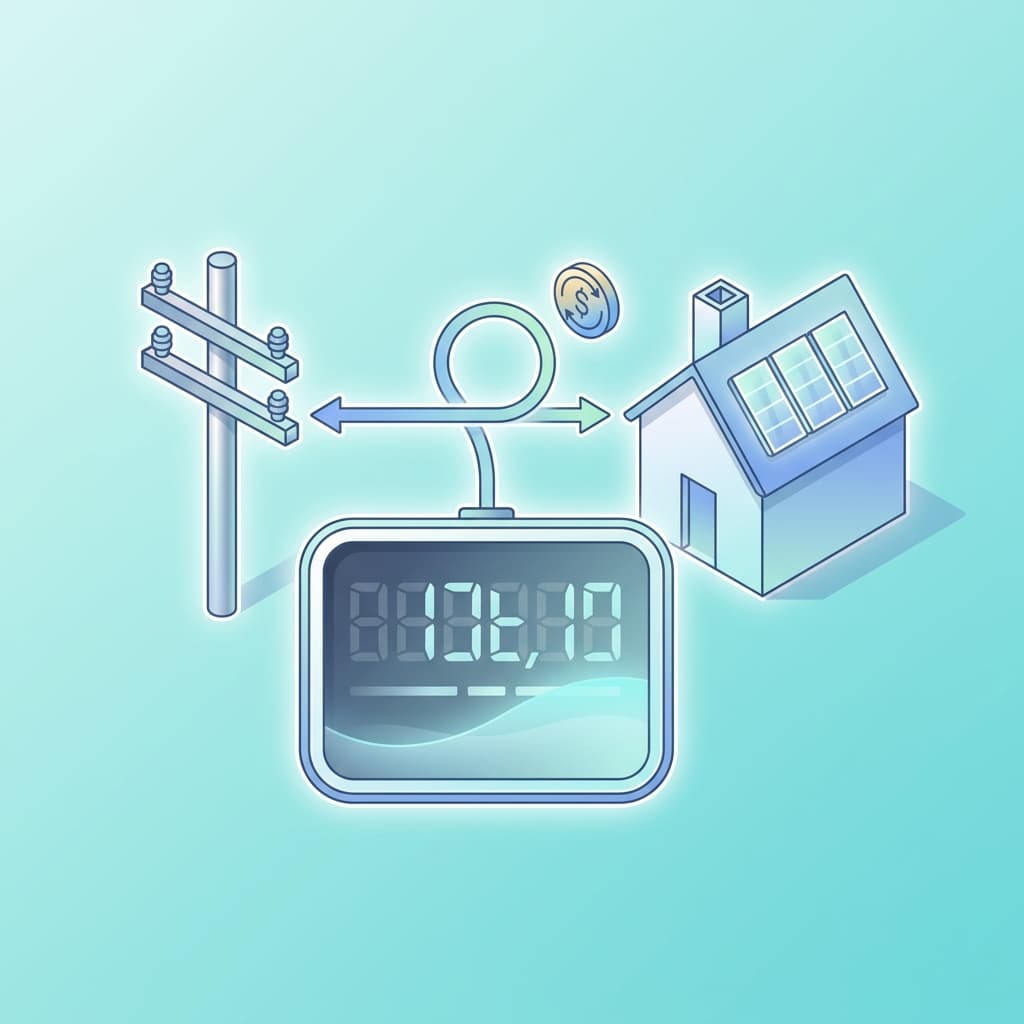
How net billing separates self-use, export, and import value
The commercial difference is not the panels. It is the accounting treatment of units you use onsite versus units you send back.
Generation flow
Demand flow
The current NEPRA framework is explicitly a net billing arrangementCopy section link
The most important update is that the official wording is no longer vague market shorthand. NEPRA's Prosumer Regulations, 2026 say the prosumer shall be billed under a net billing arrangement. In practice that means imported electricity is billed at the applicable tariff, while exported electricity is purchased separately at the national average energy purchase price after credit is given for the exported units. For buyers, the result is simple: self-consumption economics and export economics are now much more clearly separated inside the rule itself.
The official 2026 forecast makes export-heavy ROI claims easier to pressure-testCopy section link
Current NEPRA purchase-price economics mean exported units are valued materially below the import tariff. For the specific numbers and what they change in practice, see our net billing guide.
System sizing is still constrained by sanctioned load and network conditionsCopy section link
A net billing-aware buyer should not think only about kWh exports. The current prosumer rules also keep physical and connection-side constraints in play. Proposed distributed generation capacity cannot exceed sanctioned load. Applications can also be blocked where the cumulative distributed generation on a transformer reaches the prescribed threshold, and systems at or above 250 kW require a load flow study. That means an aggressive proposal can be commercially optimistic and procedurally unrealistic at the same time.
Ask which exact regulation date and SRO the supplier used in the modelCopy section link
This is where 'latest data' stops being a slogan and becomes a buyer question. NEPRA notified the Prosumer Regulations on February 9, 2026, and its news page shows a further amendment notified on April 2, 2026. So a supplier should be able to tell you which regulation version or SRO date their proposal assumes. If they cannot, there is a good chance the commercial model is running on stale policy assumptions.
Timelines matter because approval work is part of the risk profileCopy section link
The current rules are not just about rates. They also impose process steps: acknowledgement of applications, initial DISCO review, agreement signing, charge estimates, installation windows, and authority concurrence. Buyers should therefore separate installation duration from approval duration. A fast installation promise does not mean a fast energisation or billing transition if the process assumptions are weak.
Quick checklist
- ✓Ask whether the proposal assumes net metering-style export value or a lower export rate closer to net billing logic.
- ✓Check whether the recommended system size is based on your own daytime consumption or on exporting surplus units.
- ✓Review payback estimates again if the proposal depends heavily on selling excess generation back to the grid.
- ✓Ask the supplier what utility-side assumptions they are making before you approve the project size.
Frequently asked questions
For new applications, the regime has shifted. NEPRA's Prosumer Regulations 2026 use a net billing arrangement where exported electricity is purchased at the national average energy purchase price, separate from the retail tariff applied to imports. Existing agreements signed under earlier rules retain their original terms for the period stated in the original agreement.
New applications are processed under the current Prosumer Regulations 2026, which is a net billing arrangement. The terminology used by suppliers may still say 'net metering' conversationally, but the legal framework is net billing for new applications.
Yes, agreements already in force under earlier regulations continue under their original terms. Check your agreement document for its specific term and any amendment clauses.
NEPRA notified an amendment to the 2026 Prosumer Regulations. Buyers should ask suppliers which exact regulation version and notification date their proposal model assumes. If the supplier cannot name the version, treat the financial model as unverified.
No, but it shifts the economics. Systems sized around self-consumption can still pay back well. Systems that depend heavily on exporting surplus units now need to be modelled against the national average energy purchase price, not the retail tariff.
Systems at or above 250 kW require a load flow study under the current rules. That adds technical work and time to the application. A supplier proposing a system near or above this threshold should be able to explain how the load flow study fits into their timeline.
Related questions
Sources and notes
Continue with adjacent guides
Buyer action
Want to check whether your project still fits current policy assumptions?
Share your requirement and we'll help you review sizing, export assumptions, and approval logic.