

Is a solar battery worth it in Pakistan under net billing?Copy section link
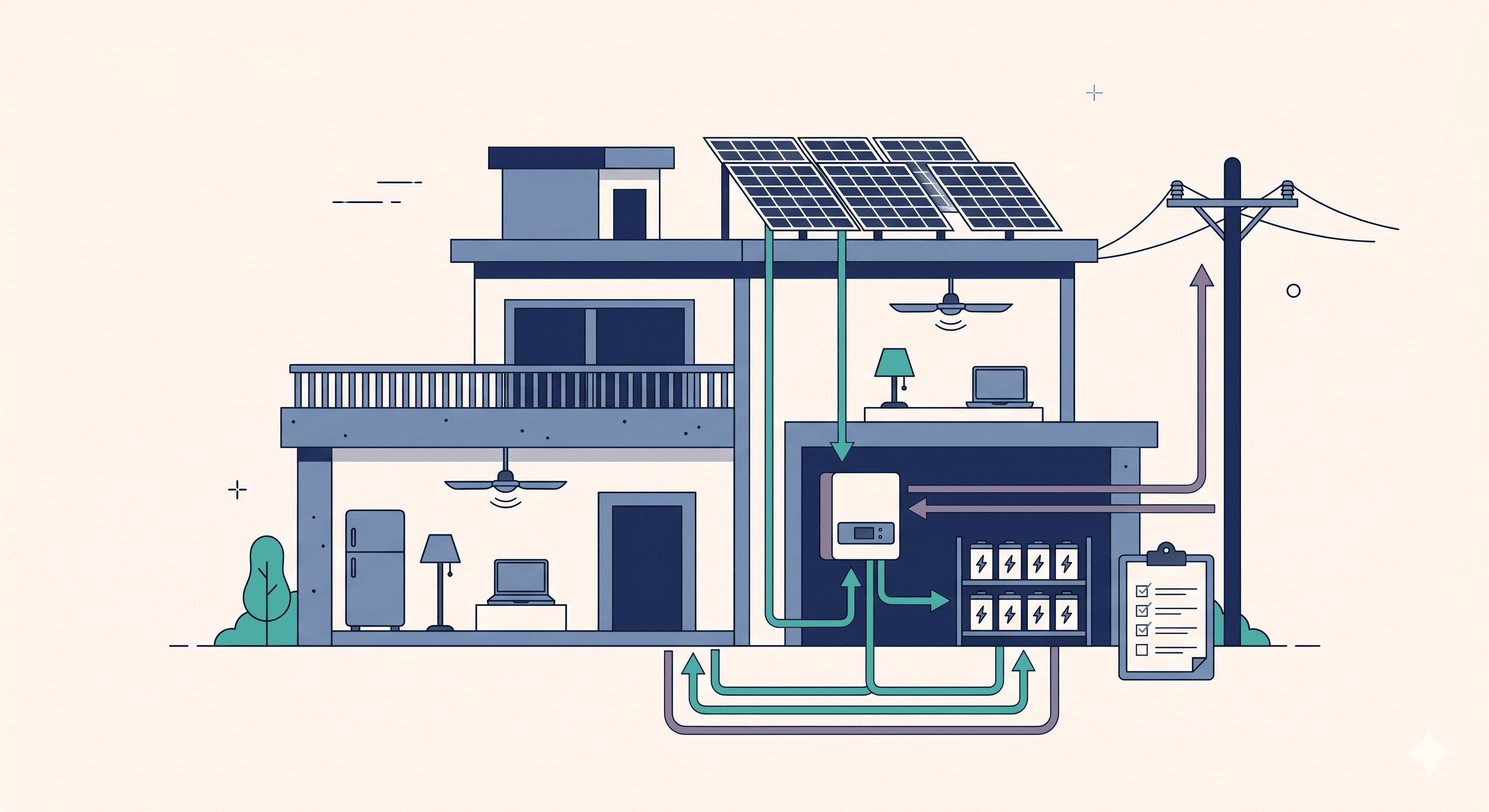
The honest answer is: only if the battery is solving a real problem. Under net billing, exported electricity is not valued the same way as imported electricity, so storing some solar generation for later use can become more interesting. But the battery also adds capital cost, conversion losses, maintenance expectations, cycle-life risk, and eventual replacement. A proposal that says batteries are automatically the smart choice is too simple. A proposal that never discusses batteries may also be incomplete for outage-sensitive sites.
Net billing changes the storage question, but not the math disciplineCopy section link
The net billing guide explains why self-consumed units and exported units should be separated. That same split should drive the battery conversation. If a battery stores energy that would otherwise be exported at a lower value and later offsets imported energy at a higher value, there may be a financial case. But that spread has to cover losses, battery degradation, replacement risk, and the higher upfront cost.
Backup sizing starts with critical load, not total system sizeCopy section link
Many weak battery proposals start with solar capacity and then attach a battery package. Better sizing starts from the load you actually want to keep running during an outage. For a home, that may mean lights, fans, internet, refrigerator, and selected sockets. For a commercial site, it may mean IT load, security systems, controls, office continuity, or a small production-critical process. The battery should be sized around those loads and the required backup duration.
Hybrid inverter selection should follow the operating planCopy section link
A hybrid inverter is not automatically better than an on-grid inverter. It is better when the buyer has a real reason to manage storage, backup, or future battery expansion. For some buyers, choosing a hybrid inverter today preserves optionality. For others, it adds cost and complexity without enough benefit. The right question is what the inverter must do over the next several years, not whether the word hybrid sounds more advanced.
Battery economics should be tested against payback, generator fuel, and outage costCopy section link
A battery may not improve a simple solar payback model, yet still be justified for a site where downtime is expensive. That is why battery economics should be shown separately from the base solar case. Use the payback claims guide to force the supplier to show which savings come from solar generation, which come from storage, and which are really resilience benefits.
Sanctioned load and system size still matterCopy section link
Storage does not remove the need to understand sanctioned load, interconnection rules, and network constraints. A supplier should still explain how the recommended PV capacity fits the connection context. If the battery is being used to justify a larger solar array, cross-check that logic against the sanctioned-load guide before treating the recommendation as straightforward.
A credible battery proposal makes trade-offs visibleCopy section link
The strongest proposals do not sell batteries as magic. They name the loads, backup hours, usable capacity, chemistry, warranty, replacement assumption, control logic, and monitoring plan. They also show what happens if the buyer chooses no battery, a smaller battery, or a battery-ready inverter only. That lets you decide whether the added cost is buying resilience, financial return, future flexibility, or simply comfort.
Hybrid sizing checklist
- ✓Separate backup requirement from financial return before comparing battery options.
- ✓Ask which loads will be backed up, for how many hours, and at what depth of discharge.
- ✓Check whether the battery is meant to reduce exports, cover outages, reduce generator runtime, or all three.
- ✓Compare the same project with and without storage before approving the added cost.
Frequently asked questions
Sometimes. A battery is easier to justify when outages, evening load, generator fuel, or operational continuity matter. It is harder to justify if the only reason is improving payback on a site that already self-consumes most daytime generation.
It can, because exported units are valued separately from imported units. But the battery still has to beat its own cost, efficiency losses, cycle life, replacement risk, and financing cost. Net billing makes the question more relevant; it does not make every battery economical.
A battery-ready design can be sensible if future backup is likely. Ask what extra cost you are paying now, what battery types are compatible later, and whether the current design still works well without storage.
Start with critical load, required backup hours, allowable depth of discharge, inverter capacity, and charging source. Do not size a battery from total monthly units alone.
They depend on outage frequency, diesel replacement value, export value, battery life, replacement cost, usable capacity, and whether the buyer values resilience as a business requirement rather than only as rupees saved.
Sources and notes
Continue with adjacent guides
Buyer action
Want to check whether storage belongs in your project?
Share your load profile and backup needs and we'll help you compare hybrid, battery-ready, and no-storage options on the same basis.