

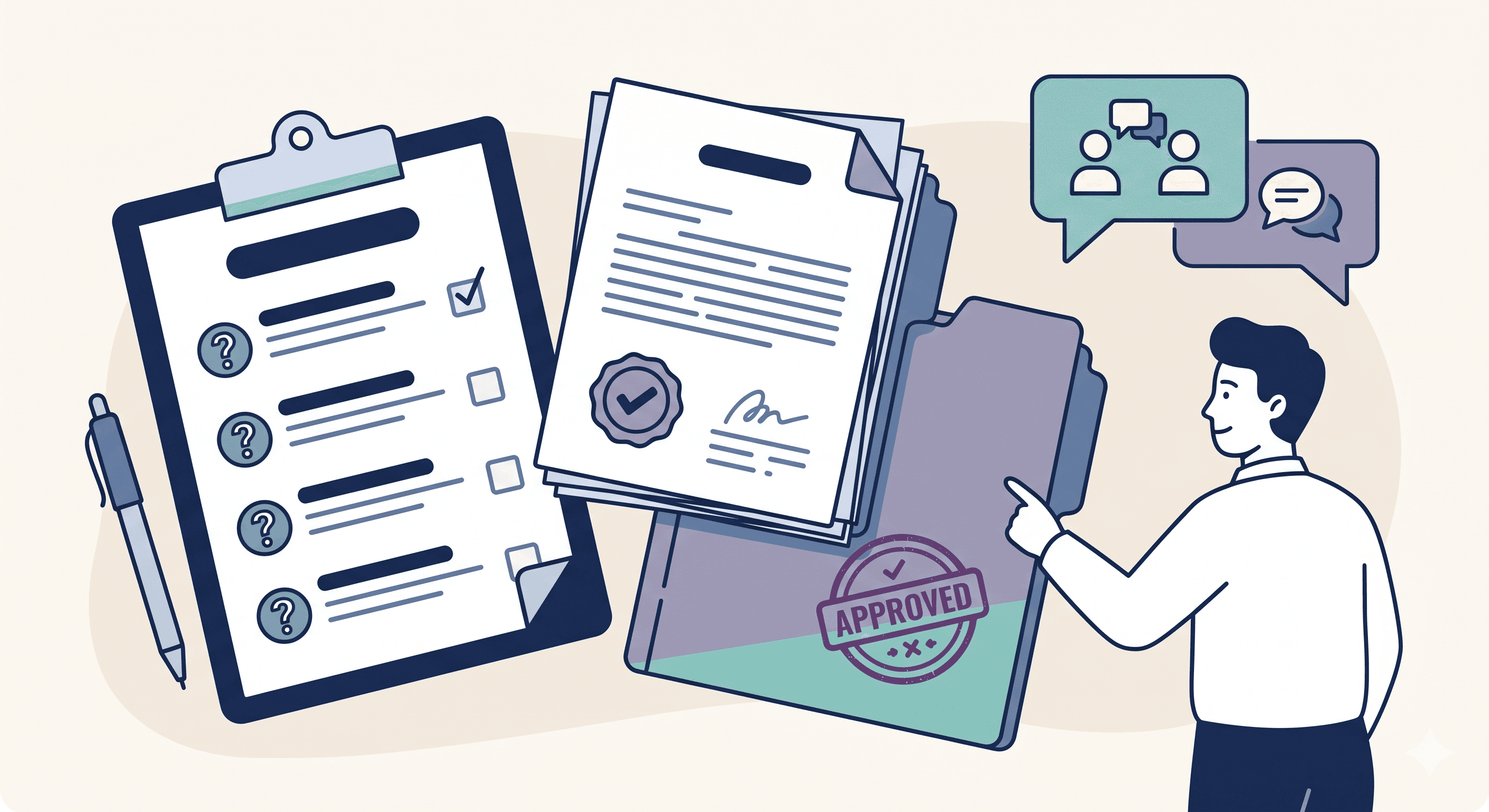
Documents to locate early
- ✓Current bill, sanctioned-load record, and account details.
- ✓CNIC or company documents required for the application.
- ✓Single-line diagram, layout drawings, inverter and module datasheets.
- ✓Commissioning, meter, agreement, and handover records after approval.
What documents are needed for a prosumer application in Pakistan?Copy section link
A buyer should expect a document pack that proves customer identity, connection details, site ownership or authorization, proposed equipment, electrical design, and agreement readiness. Exact requirements vary by DISCO and consumer type, so the safest procurement step is to ask the supplier for the current application list before award. That list should separate what the buyer provides from what the supplier prepares.
The application pack is part of supplier scopeCopy section link
This article is the document-level companion to the broader DISCO approval questions guide. Approval support should not be a vague sentence. The proposal should say who prepares forms, who produces drawings, who checks the bill details, who coordinates signatures, who submits, and who handles returned corrections.
Buyer documents usually prove identity, account, and site authorityCopy section link
The buyer side of the pack usually proves that the applicant is allowed to apply for the connection. This can include the latest electricity bill, CNIC for individuals, NTN or company documents for businesses, proof of property ownership, tenancy authorization, or board/management authorization where needed. Name and address mismatches should be corrected early because they can create avoidable back-and-forth.
Supplier documents should prove the technical designCopy section link
The supplier-prepared side usually includes the single-line diagram, system capacity detail, module and inverter datasheets, protection scheme, site layout where needed, and technical forms. This is where proposal specificity matters. If the quoted equipment is generic, the application pack may later expose a mismatch between what was sold and what is being submitted.
Sanctioned load and capacity assumptions should be checked before submissionCopy section link
The proposed capacity must fit the current connection context. Before the supplier submits, ask which sanctioned-load figure they used and whether any load enhancement or phasing is required. The sanctioned-load guide explains why this can change project realism before the documents even reach review.
Fees, charge estimates, and revisions need an ownerCopy section link
The current approval process includes utility-side review and charge-estimate steps. Buyers should ask who pays charges, who deposits them, who tracks receipts, and who handles the file if the DISCO asks for corrections. A supplier may say they assist, but assist can mean anything from full management to a WhatsApp reminder. Make the boundary explicit.
The document trail remains useful after commissioningCopy section link
Documents are not only for approval. They help with monitoring, warranty claims, ownership transfer, future expansion, and supplier accountability. Once the project is live under the current net billing framework, keep the agreement, drawings, equipment records, meter details, and commissioning evidence together.
Document readiness checklist
- ✓Ask the supplier for the application document list before award.
- ✓Separate buyer-provided documents from supplier-prepared drawings and forms.
- ✓Confirm who handles revisions, fees, charge estimates, and follow-up.
- ✓Keep signed agreements, meter records, drawings, and handover documents together after approval.
Frequently asked questions
Typical packs include the utility bill, CNIC or company documents, proof of ownership or authorization, application forms, equipment datasheets, single-line diagram, site details, and the prosumer agreement. Exact requirements can vary by DISCO and project type.
The supplier or qualified technical party should prepare it. The buyer should ask for a copy and confirm it matches the proposed equipment, protection scheme, and connection assumptions.
Current rules have defined application, review, agreement, charge estimate, installation, and concurrence stages. Buyers should ask the supplier to separate on-site work from utility-side approval assumptions.
Common causes include incomplete documents, mismatched names or addresses, missing drawings, unclear sanctioned-load assumptions, unpaid charges, returned revisions, and weak follow-up ownership.
They should at least be disclosed clearly. Ask whether government or utility charges are included, reimbursable, excluded, or payable directly by the buyer.
Sources and notes
Continue with adjacent guides
Buyer action
Want to check whether your approval documents are covered?
Share your project details and we'll help you compare supplier responsibility for application documents, revisions, fees, and follow-up.