

What is C&I solar procurement in Pakistan?Copy section link
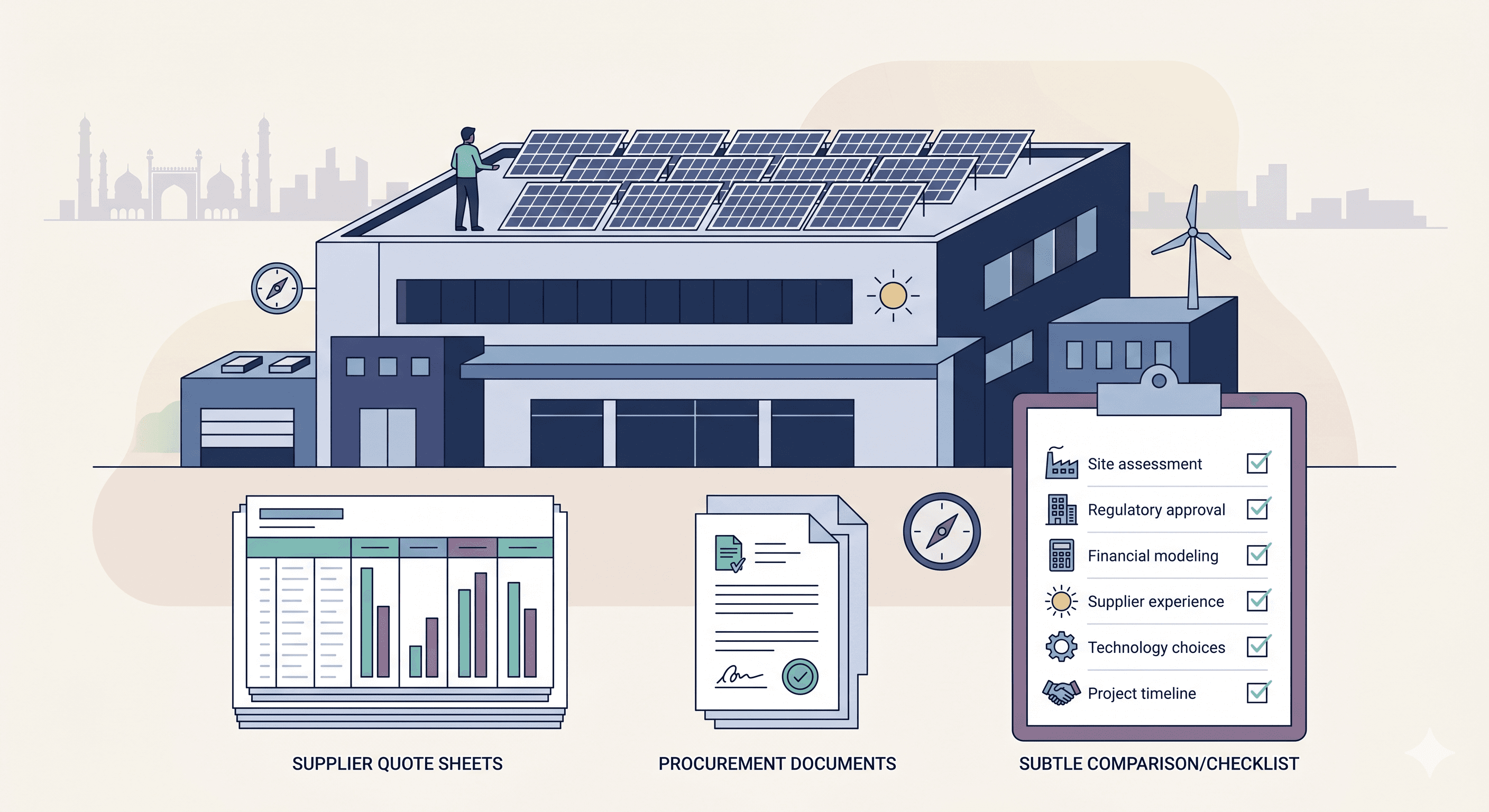
Commercial and industrial solar procurement is the structured process of defining a site's load, constraints, commercial assumptions, approval path, supplier scope, and operating accountability before awarding a solar project. In Pakistan, the procurement job is now more policy-sensitive because net billing separates self-consumption value from export value, and larger projects can trigger additional utility-side checks.
Start with load profile, not system sizeCopy section link
C&I buyers should begin with how the site actually consumes electricity across the day, week, and season. A factory with steady daytime load can absorb generation differently from a warehouse, school, cold storage site, or office tower. If the proposal starts with roof area or a target kW before the load profile is understood, the project may be sized for sales appeal rather than usable value.
Net billing changes the C&I sizing conversationCopy section link
Under current net-billing logic, self-consumed units and exported units do not carry the same economic value. That does not make C&I solar weak; it makes sizing discipline more important. Sites with strong daytime load can still have a compelling case, but export-heavy recommendations should be checked against the net billing guide before the buyer approves capacity.
Sanctioned load and utility constraints can reshape the projectCopy section link
For larger sites, the technical and approval path can matter as much as the equipment price. Current rules constrain proposed capacity against sanctioned load, and systems at or above 250 kW require a load flow study. If the supplier has not checked the connection context, the project can look attractive commercially while being weak procedurally. Use the sanctioned-load guide to pressure-test aggressive recommendations.
Normalize supplier scope before comparing priceCopy section link
A C&I proposal comparison only works when every supplier is pricing the same job. Structure, protections, cable routes, earthing, shutdown coordination, monitoring, approvals, taxes, commissioning records, and handover documents can all vary. Before ranking price, normalize each offer against the same scope basis using the proposal comparison guide.
Commercial terms should protect operations, not only budgetCopy section link
C&I solar affects an operating site. A supplier's timeline should account for shutdown windows, safety access, equipment delivery, testing, commissioning, and internal stakeholder approvals. A cheap proposal that creates avoidable downtime, weak monitoring, or unclear warranty handling can cost more than it saves.
Post-handover accountability belongs in the award decisionCopy section link
The procurement process should not end at installation. C&I buyers need monitoring access, commissioning evidence, warranty records, escalation paths, and performance review routines. If those are missing, the buyer may struggle to prove whether underperformance is a design issue, maintenance issue, grid issue, or warranty claim.
C&I procurement checklist
- ✓Start with load profile and self-consumption, not roof area or headline kW.
- ✓Confirm sanctioned load, transformer constraints, and whether a load flow study may apply.
- ✓Normalize supplier proposals on scope, equipment, approvals, payment terms, handover, and monitoring.
- ✓Ask for base-case and downside-case economics under current net-billing assumptions.
- ✓Make post-commissioning accountability part of award criteria, not an afterthought.
Frequently asked questions
C&I projects are more sensitive to load profile, shutdown windows, sanctioned load, transformer constraints, safety requirements, monitoring, approvals, and operational accountability. A larger system size makes weak assumptions more expensive.
Start with daytime load, sanctioned load, roof or land constraints, utility connection status, billing history, operating hours, and internal approval requirements. Suppliers should not size the project confidently without these inputs.
Not necessarily. Many C&I sites have strong daytime consumption, which can make self-consumption economics resilient. Export-heavy designs need more scrutiny because exported units are valued differently from imported units.
Under current prosumer rules, systems at or above 250 kW require a load flow study. That can affect timeline, documentation, and approval risk, so it should be discussed before award.
Compare suppliers on normalized scope, exact equipment, technical design basis, approval responsibility, commercial terms, safety plan, monitoring, warranty handling, and downside-case economics. Price only becomes meaningful after those are aligned.
Sources and notes
Continue with adjacent guides
Buyer action
Want to structure a C&I solar request before suppliers quote?
Share your site and load details and we'll help you compare suppliers on scope, sizing, approvals, and execution responsibility.