

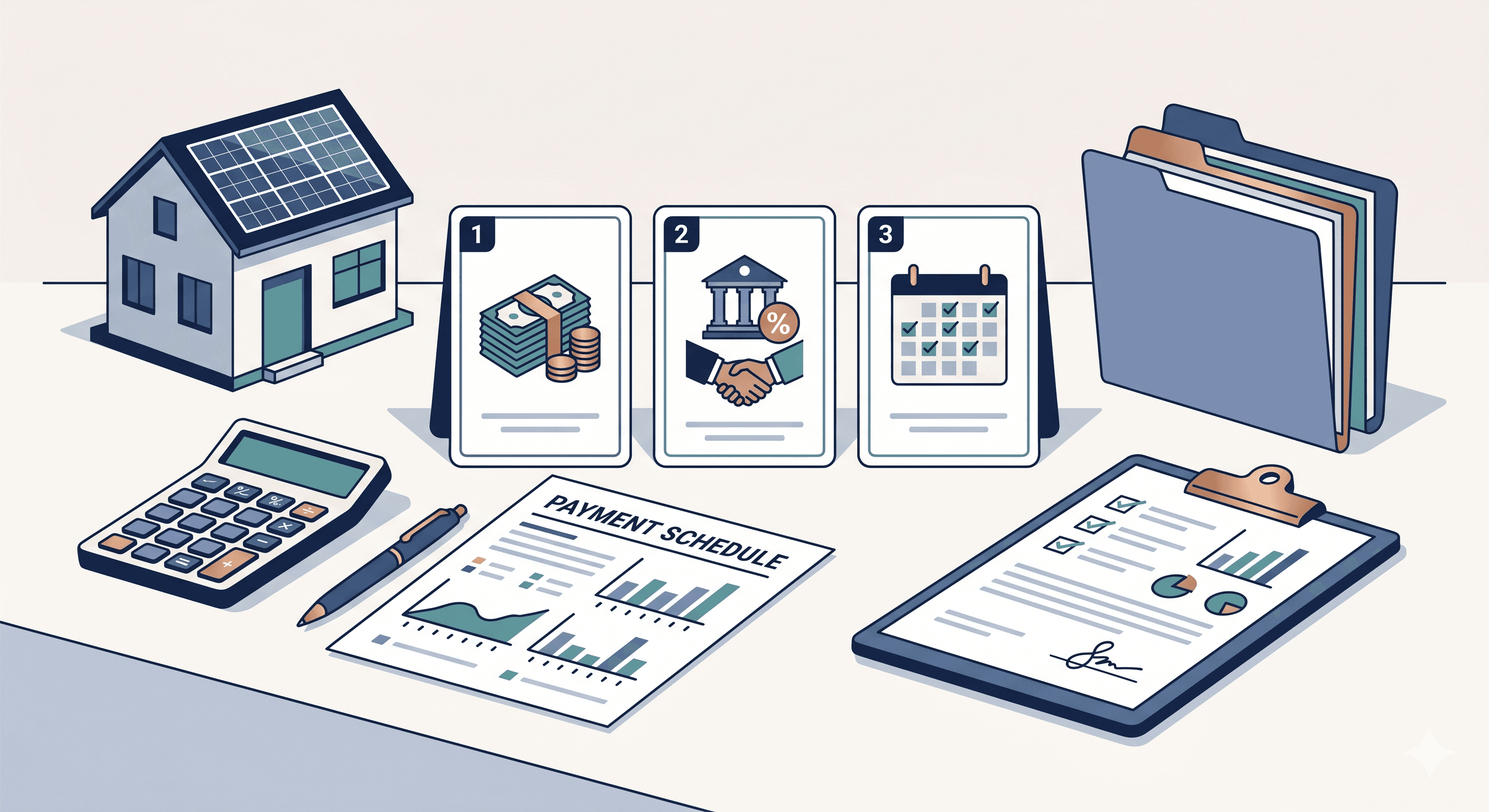
What solar financing options are available in Pakistan?Copy section link
Solar buyers in Pakistan may encounter several structures: cash purchase, bank financing, supplier installment plans, lease-style arrangements, or commercial equipment finance. Each structure changes who owns the system, who carries performance risk, how savings are counted, and what happens if the buyer wants to expand, sell the property, or exit early. The decision should not be based only on monthly affordability.
Financing changes payback because capital has a costCopy section link
A solar system can have a good technical case and a weaker financed case if the markup, fees, or tenor are not modelled correctly. Use the payback claims guide to compare the project both before and after financing cost. The supplier's payback number should not ignore the cost of money.
Cash purchase gives clarity, but not always the best capital decisionCopy section link
Paying cash makes ownership, warranty, and savings easier to understand. The buyer owns the asset and receives the benefit directly. But businesses may still prefer financing if cash is needed for inventory, production, working capital, or higher-return investments. The right comparison is not cash versus debt in the abstract; it is solar return versus the buyer's alternative use of capital.
Bank financing should be checked against current scheme availabilityCopy section link
State Bank of Pakistan has maintained incentive and refinance scheme information for renewable energy and industrial financing, but live availability depends on bank participation, policy status, credit profile, and documentation. Buyers should verify current bank terms directly rather than relying on a supplier's old financing slide.
Supplier installment offers need contract-level scrutinyCopy section link
Installments can be useful, but they also require the same diligence as supplier selection. Use the 12 supplier questions to ask who owns the system during repayment, whether warranty rights transfer immediately, what happens after late payment, and whether maintenance is included or sold separately.
Commercial buyers should compare accounting, tax, and operating responsibilityCopy section link
For C&I buyers, financing is also an accounting and operations question. Ownership model, depreciation treatment, insurance, maintenance responsibility, and procurement approval rules may matter as much as monthly payment. A proposal should give finance, operations, and procurement teams enough detail to review the same project from different angles.
The strongest financing comparison keeps technical scope fixedCopy section link
Do not let financing structure blur scope. First normalize the technical proposal: equipment, protections, approvals, monitoring, warranty, and handover. Then compare cash and financed structures against that same scope. Otherwise a financed offer may look attractive simply because it quietly uses lower-cost equipment or a narrower delivery responsibility.
Financing comparison checklist
- ✓Compare cash price, financed price, monthly payment, markup, fees, and total repayment.
- ✓Ask who owns the system, warranty rights, insurance responsibility, and monitoring access.
- ✓Model payback with financing cost included, not only equipment cost.
- ✓Read early settlement, default, transfer, and maintenance clauses before signing.
Frequently asked questions
Buyers may see cash purchases, bank loans, supplier installment plans, lease-style or operating models, and business financing tied to broader equipment facilities. Availability and terms vary by bank, buyer profile, and project type.
Financing can improve cash flow, but it does not automatically improve payback. Markup, fees, tenor, insurance, and ownership terms must be included in the model.
No. A low payment can hide longer tenor, higher total repayment, excluded maintenance, weak warranty handling, or escalation clauses.
That depends on cost of capital, tax position, cash priorities, downtime risk, and the strength of the project economics. Compare cash and financed cases side by side.
Ask the total repayment, markup or implied finance charge, equipment ownership, warranty rights, late-payment consequences, and what happens if performance is below forecast.
Sources and notes
Continue with adjacent guides
Buyer action
Want to compare cash and financed solar options clearly?
Share your quote and financing terms and we'll help you review payback, total repayment, ownership, and supplier responsibility.